
7 Best Appcues Alternatives & Competitors for SaaS Teams (2026)
This article compares seven Appcues alternatives by pricing, strengths, limitations, and the teams they fit best. We will also explain when Appcues is still the better choice.
In this post
The alternatives
We’ve organized these by company size because a five-person startup has fundamentally different needs from a 500-person company with a dedicated product ops team.
For small teams and startups
1. FlowNavi
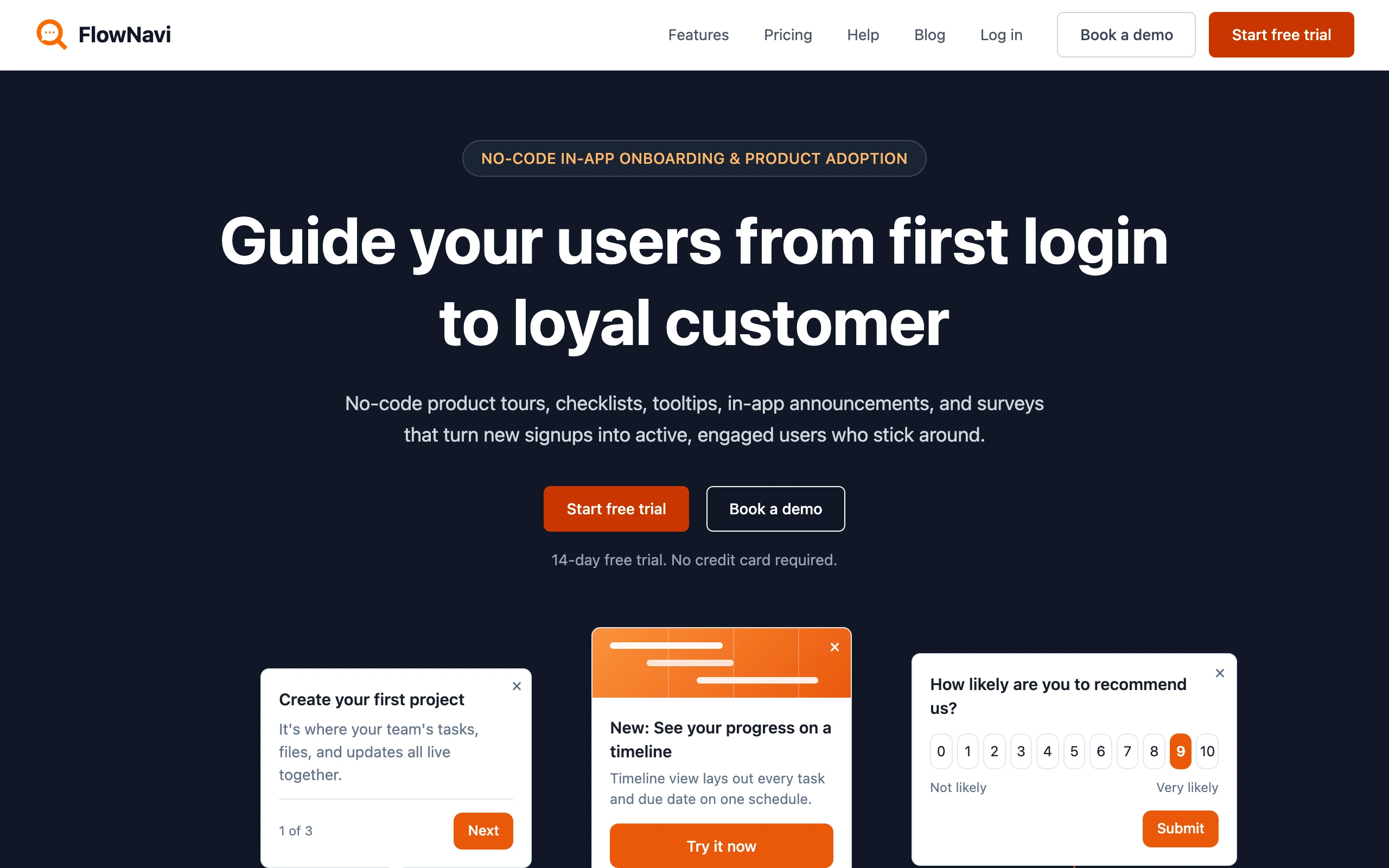
FlowNavi is a no-code tool for in-app onboarding and product adoption: product tours, checklists, tooltips, hotspots, in-app announcements, and NPS and custom surveys.
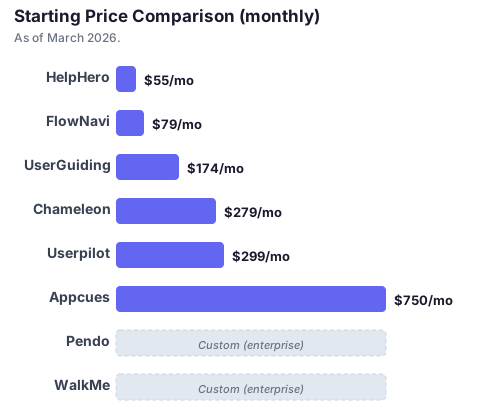
Pricing: Starts at $79/month. Free trial available.
What it does well: The two things that stand out against Appcues are pricing and simplicity. FlowNavi starts at $79/month, and requires less setup than Appcues. Appcues charges an extra one-time implementation fee, FlowNavi on the other hand has a more straightforward initial setup. Most teams have their first guides up within a day or two.
Where it falls short: There’s no multi-channel messaging (FlowNavi is in-app only, no behavioral email or push notifications), no mobile SDKs, and no deep analytics like funnels or session replay. If you need those, Appcues or the bigger platforms below are the better fit.
Best for: SMB and mid-market SaaS teams that want simple, no-code in-app onboarding and adoption, and don’t need Appcues’ multi-channel messaging or mobile SDKs.
Disclosure: FlowNavi is our own product.
For a full comparison, see FlowNavi vs Appcues.
2. HelpHero
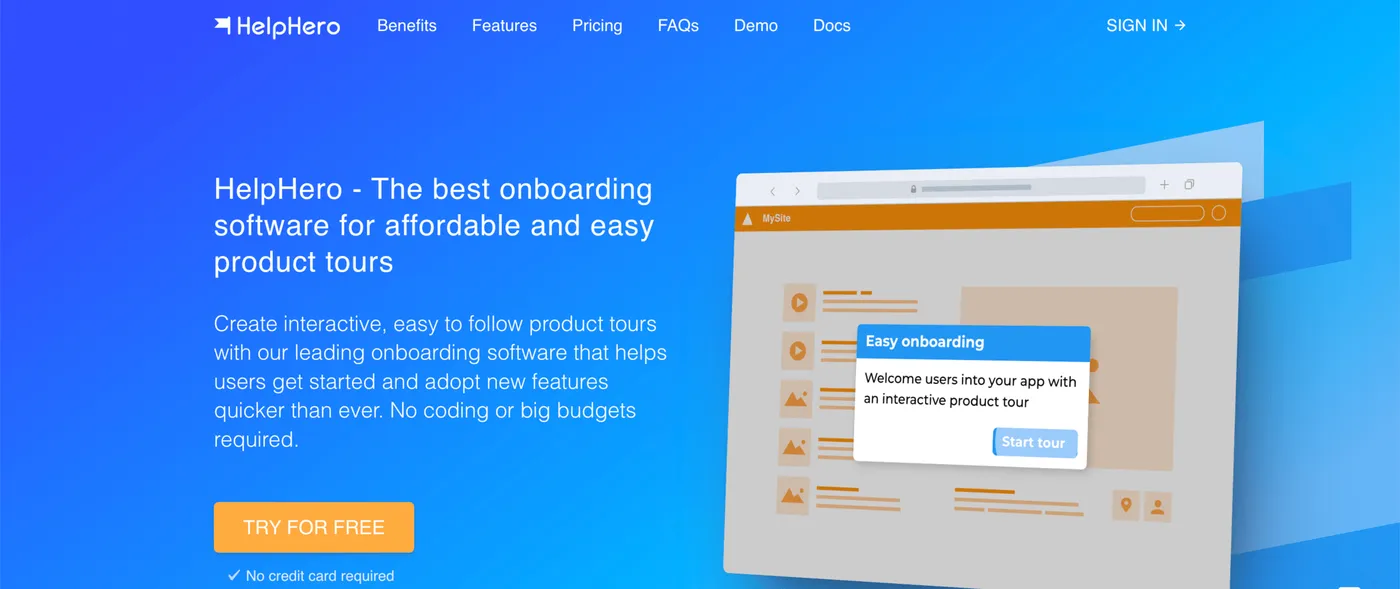
HelpHero is the most stripped-down option on this list, and the cheapest. It does one thing well: product tours and tooltips, with a no-code builder.
Pricing: Starts at $55/month.
What it does well: Very simple to set up. The feature set is small enough that there’s almost nothing to learn. If your only requirement is “I want to add a guided tour to my app,” HelpHero is the most direct path to that, at the lowest price.
Where it falls short: Limited survey options. Basic analytics. As soon as you need more than tours and tooltips, you’ll feel the ceiling.
Best for: Early-stage products where the only onboarding need is a basic tour, and budget is the deciding factor.
For mid-size teams
3. UserGuiding
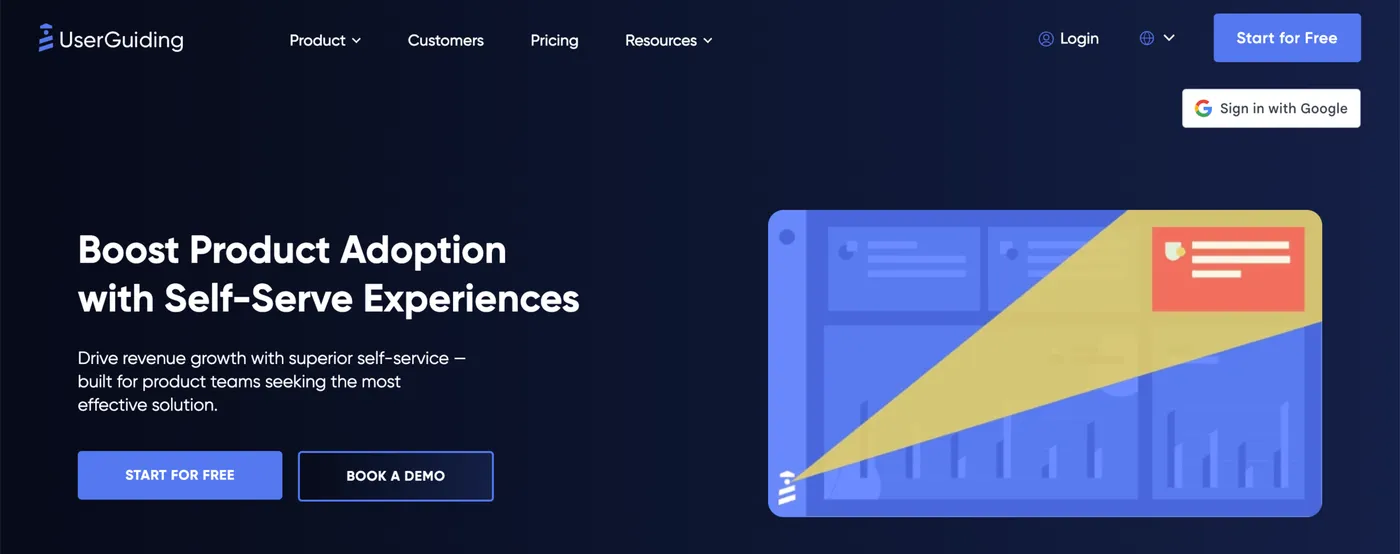
UserGuiding is a mid-market all-in-one: tours, tooltips, checklists, resource centers, and surveys, with a knowledge base and an AI support assistant in the same subscription.
Pricing: Starts at $249/month. Free trial available.
What it does well: The knowledge base is the standout. UserGuiding consolidates onboarding flows and help docs in one place, which means less tool sprawl. The interface is also genuinely beginner-friendly, and they offer 24/7 support along with a 30-day money-back guarantee, both rare in this space.
Where it falls short: The entry plan allows only one checklist and one survey. Customization is limited. Multiple G2 reviewers mention that the styling options feel restrictive, so your tours may look obviously “third-party” rather than native to your app. Analytics are basic. No mobile support.
Best for: Mid-size teams that want onboarding and a help center in one tool with a straightforward interface, and don’t need deep customization.
For a deeper dive, see our 10 UserGuiding alternatives compared.
4. Userpilot
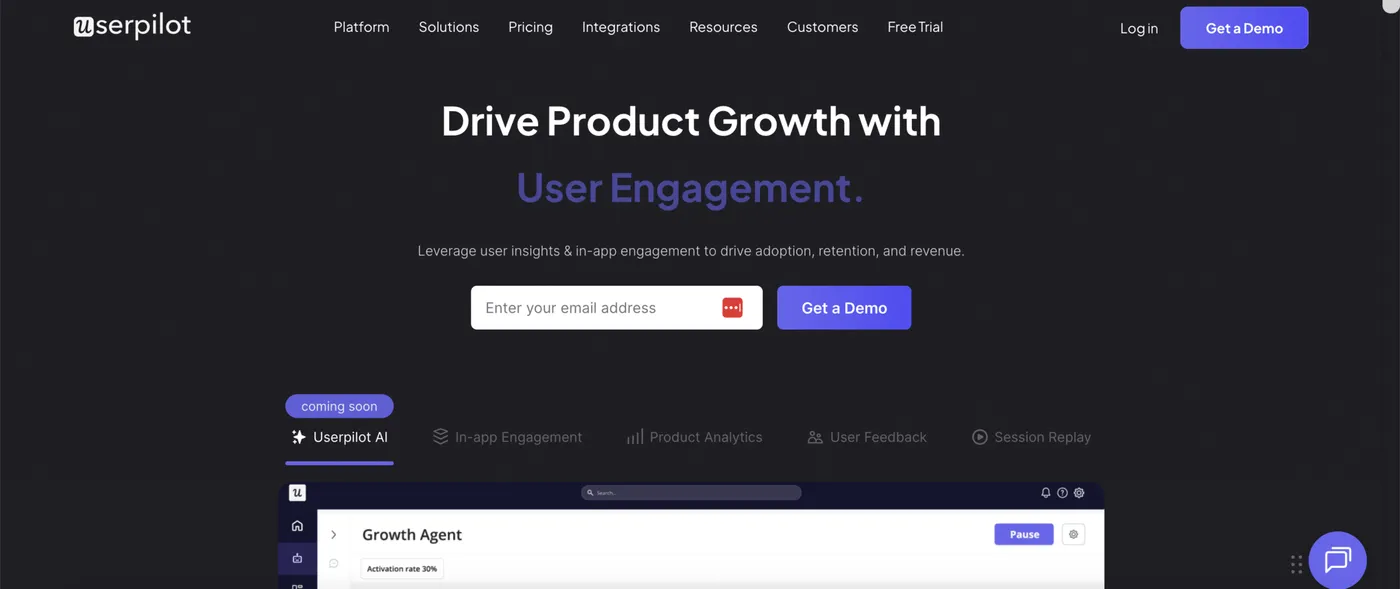
Userpilot is probably Appcues’ most direct competitor. They position themselves as an all-in-one product growth platform: onboarding, analytics, and user feedback in one tool.
Pricing: Starts at $299/month. Free trial available.
What it does well: The analytics are genuinely deeper than Appcues. You get funnels, paths, retention reports, session replays, and custom dashboards without needing a separate analytics tool. If your main frustration with Appcues is the shallow analytics, Userpilot directly addresses that. They also include surveys (NPS, CSAT, CES, PMF) which Appcues handles poorly.
Where it falls short: The deeper analytics sit on the Growth plan, which starts at $849/month; the $299 Starter plan only includes usage trends. Mobile SDKs are a paid add-on on Growth. Starter is billed annually, so you’re committing to a year upfront. Several reviewers mention a learning curve because there are so many features.
Best for: Mid-size product teams that want analytics and onboarding in one tool, and are frustrated with Appcues’ shallow data.
For a deeper dive, see our 11 Userpilot alternatives compared.
5. Chameleon
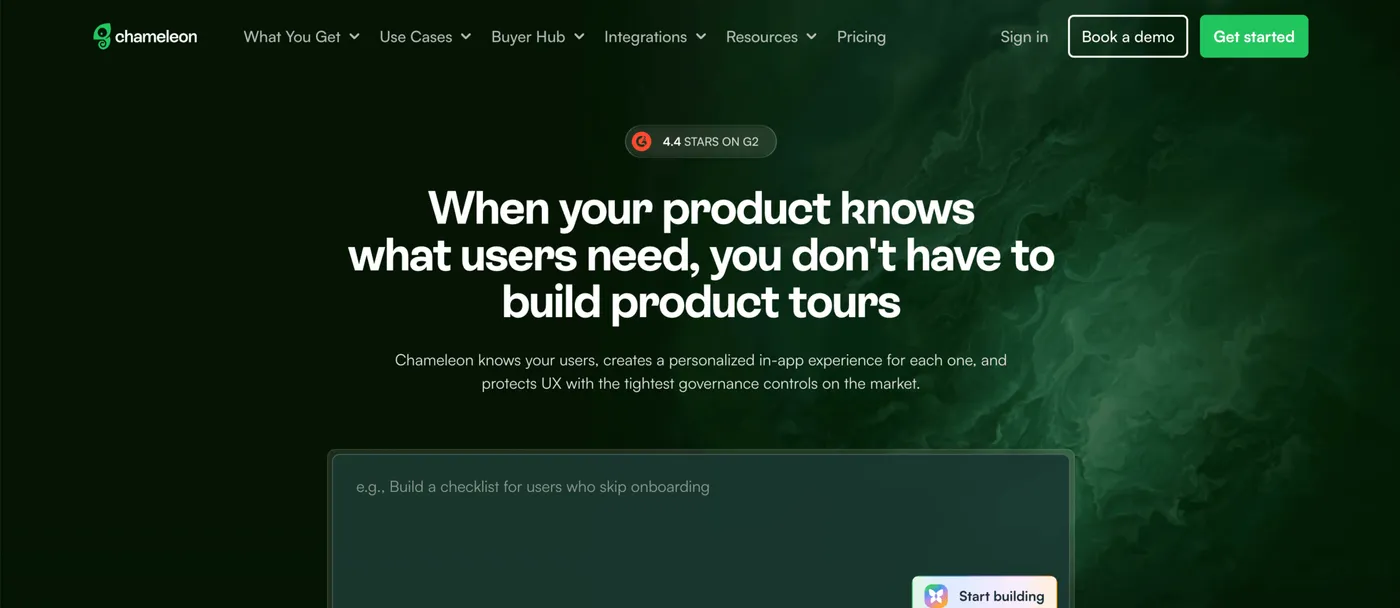
Chameleon positions itself as the UX-conscious option. The pitch is that onboarding shouldn’t feel like a third-party overlay bolted onto your app.
Pricing: Starts at $279/month. Free trial available.
What it does well: Customization is the standout. You can style every element with custom CSS, which means your onboarding can look completely native to your app. Every onboarding tool has edge cases where tours break on certain page structures. Chameleon puts more effort than most into handling those edge cases, which matters if your app has a complex frontend.
Where it falls short: That customization comes with complexity. You may need front-end developers to handle the styling. G2 reviews are mixed: some love it, others call it “hard to use in practice, buggy in a lot of areas.” The price jumps steeply from Startup to Growth.
Best for: Design-conscious product teams with frontend resources who prioritize brand consistency over speed of setup.
For large companies
6. Pendo
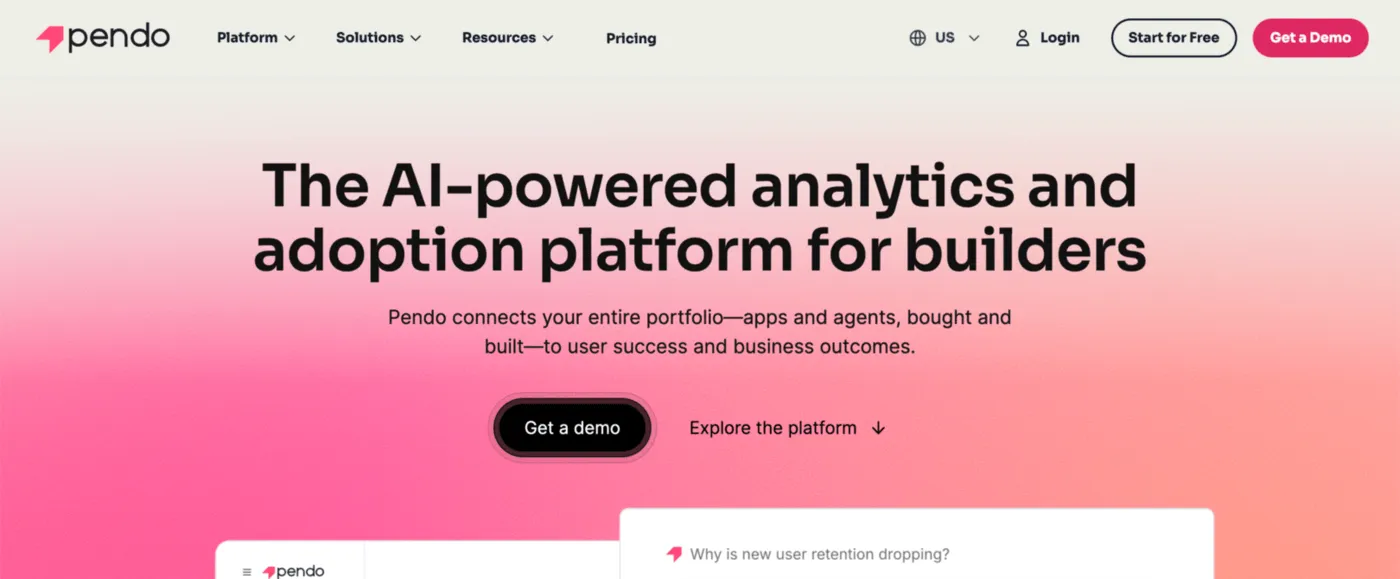
Pendo is the analytics-first option. It’s a product experience platform that combines deep analytics with in-app guidance, feedback collection, and product planning tools.
Pricing: Free plan available. Paid plans not publicly listed.
What it does well: Analytics, full stop. Pendo’s analytics are significantly deeper than anything else on this list. Custom dashboards, funnels, paths, cohorts, session replays, AI-powered insights. If you’re a product team that lives in data, Pendo is built for you. It also works for both customer-facing and internal employee tools.
Where it falls short: The onboarding and guidance features are secondary to the analytics. Checklists are only visible inside the resource center. The learning curve is steep, and the price puts it out of reach for smaller teams. Multiple reviewers note that the platform can be overwhelming for beginners.
Best for: Mid-market to enterprise product teams that want deep analytics and can justify the price. If you’re evaluating Pendo as an “Appcues alternative,” you’re probably comparing products in different categories. Pendo is an analytics platform with onboarding features. Appcues is an onboarding platform with basic analytics.
For a deeper dive, see our 13 Pendo alternatives compared.
7. WalkMe
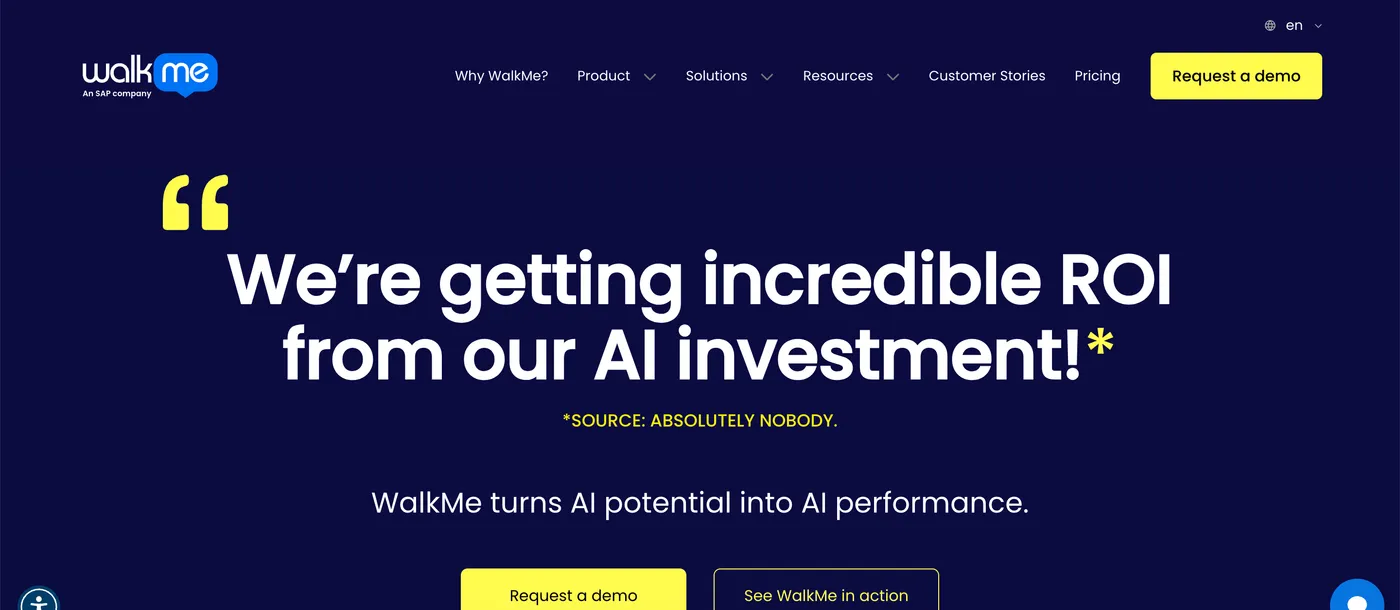
WalkMe is the enterprise play. It’s a digital adoption platform designed primarily for employee training on complex internal tools (Salesforce, SAP, Workday), though it also supports customer-facing apps.
Pricing: Not publicly listed. Enterprise sales only.
What it does well: Workflow automation across multiple applications, auto-translation for dozens of languages (including right-to-left languages like Arabic), SCORM compliance for LMS integration, and enterprise-grade support. If you’re deploying onboarding across complex enterprise software stacks, WalkMe was built for that.
Where it falls short: Massively overkill for SaaS product teams. The learning curve is steep (multiple G2 reviewers struggled with advanced logic-based flows). Support quality gets mixed reviews despite the enterprise price tag. If your use case is “I want to add a product tour to my SaaS app,” WalkMe is like buying a semi-truck to go grocery shopping.
Best for: Large enterprises deploying digital adoption across complex internal tool stacks. Not really an Appcues alternative for most readers of this post, but included because you’ll see it on every comparison list and you should understand why.
When Appcues is still the better choice
Appcues remains a strong choice when you need capabilities that most lower-cost alternatives do not offer.
Multi-channel messaging. Appcues combines in-app experiences with behavioral email and push notifications. Most onboarding tools on this list focus on in-app guidance only.
Native mobile support. Appcues provides SDKs for mobile apps as well as support for web products. If native iOS or Android onboarding is essential, the shortlist becomes much smaller.
A mature product and ecosystem. Appcues has been around since 2013, has extensive documentation, and integrates with many analytics and CRM tools. Its support also receives positive mentions in G2 reviews.
Appcues pricing
Appcues does not publish prices for its main Start, Grow, and Enterprise plans. Quotes vary based on MAUs, installations, and published experiences:
- Start: Up to 3,000 MAUs, 10 published experiences, and 12 months of reporting history.
- Grow: Starts at 3,000 MAUs, with 25 published experiences and 24 months of reporting history.
- Enterprise: Custom MAU volume, 100 published experiences, 36 months of reporting history, and enterprise support.
Appcues says every main plan includes all experience types, features, and integrations. The tiers primarily change capacity, reporting history, and service level rather than unlocking the core product.
For eligible companies with 25 or fewer employees, the separate Spark plan costs $3,600 per year plus a one-time $250 implementation fee. It includes up to 1,000 MAUs, 10 published experiences, and 12 months of reporting history.
How to decide
If you’ve read this far, you might be hoping for a “just pick this one” recommendation. We don’t think that’s useful. The right tool depends on your context, and here’s a rough framework for thinking through it:
Start with the problem, not the feature list. Are you trying to reduce churn during the first session? Drive adoption of a specific feature? Reduce support tickets? The answer shapes which tool fits. If you only need product tours and checklists, you don’t need a platform that also does analytics, session replays, and email campaigns. You’ll pay for features you don’t use.
Match the tool to your company size. This is a rough heuristic, but it works:
- Small company: You want fast setup, low price, minimal ongoing maintenance. FlowNavi or HelpHero. You don’t need enterprise features, and you likely can’t afford enterprise prices.
- Medium sized company: You probably have a product team or PM who owns onboarding. Appcues, UserGuiding, Userpilot, or Chameleon all work here. The deciding factor is usually whether you need a help center bundled in (UserGuiding), analytics bundled in (Userpilot), deep customization (Chameleon), or multi-channel messaging (Appcues).
- Large enterprise: Start considering Pendo for analytics-first product work, or WalkMe if you need to train employees on internal tools. At this scale, you’re buying from established vendors with enterprise support and security certifications.
Consider what you’ll outgrow. If you pick a lightweight tool today and your product takes off, you’ll probably need to migrate to something more capable within a year or two. That migration costs time and disrupts live onboarding flows. On the other hand, if you pick Pendo at $48.5k/year for a product that has 200 users, you’re burning money on capabilities you won’t use for years. There’s no perfect answer here, but think one step ahead, not three.
Don’t overweight feature checklists. Every tool on this list has a feature comparison page that makes their checkboxes look better than the competition’s. The features that actually matter depend on your specific situation. Mobile support is irrelevant if you don’t have a mobile app. Multi-language support is critical if you serve international users and worthless if you don’t. Filter for what you need, not what looks impressive on a grid.
Summary
| Tool | Best for | Starting price | Key strength |
|---|---|---|---|
| FlowNavi | Small teams | $79/mo | Affordable in-app guidance |
| HelpHero | Small teams | $55/mo | Simple, minimal, cheapest option |
| UserGuiding | Mid-size | $249/mo | Intuitive no-code interface, easy for non-technical teams |
| Userpilot | Mid-size | $299/mo | Built-in analytics + onboarding in one tool |
| Chameleon | Mid-size | $279/mo | Deep CSS customization, pixel-perfect branding |
| Appcues | Mid-size | $300/mo | Multi-channel messaging (in-app + email + push) |
| Pendo | Enterprise | Custom | Best-in-class product analytics |
| WalkMe | Enterprise | Custom | Employee training at enterprise scale |
Every other “alternatives” post on this topic is written by a vendor pretending to be objective. We’re a vendor being upfront about it. But if you’re a growing company that needs analytics depth, Userpilot is probably a better fit. If you need multi-channel messaging, Appcues genuinely does that well. If you’re an enterprise, Pendo or WalkMe are built for you.
FAQ
What’s the cheapest Appcues alternative?
HelpHero at $55/month is the cheapest paid option on this list. FlowNavi at $79/month is close behind.
Are there free or open-source Appcues alternatives?
There are several open-source JavaScript libraries:
- Driver.js MIT-licensed, lightweight library.
- Shepherd.js More flexible and feature-rich than Driver.js.
- React Joyride A solid choice if you’re building in React specifically.
The trade-off is that you get tours only and any additional features (e.g. analytics or segmentation) need to be implemented and maintained by your engineering team.
What’s the difference between Appcues and Userpilot?
Userpilot has deeper analytics built in (funnels, paths, retention reports, session replays) and includes more survey types (NPS, CSAT, CES, PMF). Appcues includes multi-channel messaging (in-app + email + push) and native mobile SDKs on every plan, where Userpilot keeps email for its Growth plan and sells mobile SDKs and push as a paid add-on.
Pick Userpilot if your main frustration with Appcues is shallow analytics. Pick Appcues if you want email, push, and mobile included from the entry plan.
Is Pendo a good Appcues alternative?
Pendo and Appcues are in different categories. Pendo is an analytics-first product experience platform with onboarding features attached. Appcues is an onboarding-first platform with basic analytics. Pendo also costs significantly more (typically $20K+/year vs Appcues’ $3.6K/year on the entry plan).
Pendo is a good alternative if you’re a mid-market or enterprise team that wants product analytics and onboarding in one tool, and your budget can absorb the price. For small or growing teams, it’s almost always overkill.
Can I use Intercom Product Tours instead of Appcues?
Yes, but with caveats. Intercom Product Tours is now part of the “Proactive Support Plus” add-on at around $99/month, which sits on top of your base Intercom subscription. It works well if you’re already invested in Intercom for chat and support. The tour-building features are less sophisticated than dedicated onboarding tools, but they cover the basics.
If you’re not already paying for Intercom, a standalone onboarding tool will give you more capability for less total spend.
Which Appcues alternative is best for mobile apps?
Honestly, this is where Appcues genuinely shines and most alternatives fall short. Native mobile onboarding requires platform SDKs, not just a JavaScript snippet, and most tools in this space are web-only. Your real options for native iOS/Android are: Appcues, Pendo, WalkMe, or Userpilot (as a paid add-on on its Growth plan). HelpHero, UserGuiding, FlowNavi, Chameleon, and most others support web only.
If mobile is your primary use case, sticking with Appcues might be the right call.